First to RSI Isn't the Winner: Why the Race to Recursive Self-Improvement Misses the Point
There's an almost religious fervor in the AI frontier labs right now, and it's all centered on one goal: being first to achieve recursive self-improvement. The thinking goes like this: whoever reaches RSI first will accelerate so quickly that no one else will ever catch up. It's a winner-takes-all mindset that assumes timing is everything—that being a week or even a month ahead will create an insurmountable advantage. These labs are putting all their chips in this basket, treating everything else as noise and focusing singularly on this milestone. The logic seems sound on the surface: the first to RSI gets exponential acceleration, and with sufficient compute, they win the superintelligence race permanently.
But I want to propose a counter-argument that challenges this assumption. As someone who's spent over 25 years building software systems and now works on agent orchestration systems while actively exploring how AI is transforming software engineering, I've learned that the path to optimization is rarely straightforward. The frontier labs' race-to-RSI strategy assumes that reaching the milestone is equivalent to winning the game. I believe they're making a fundamental error that stems from not fully accounting for the non-deterministic nature of these models and the reality of optimization landscapes.
The Non-Deterministic Nature of AI Models
Here's what the RSI-obsessed camps seem to be overlooking: these models are fundamentally non-deterministic. Give the same model the exact same problem with identical, detailed specifications, and you'll get different results every single time. This isn't a bug; it's a core characteristic of how these systems work. Even if you construct a perfect recursive self-improvement loop—where the model systematically reviews itself, identifies areas for improvement, runs tests on potential enhancements, and selects the best strategy to move forward—the outputs will still vary. The implications of this are profound and directly undermine the "first to RSI wins" thesis.
Consider this thought experiment: take two identical models, both equipped with recursive self-improvement capabilities, and start them at exactly the same time. Despite being identical twins at the starting line, one will inevitably end up better than the other. Why? Because at each decision point in their improvement loops, they'll make slightly different choices based on their non-deterministic nature. One might test a particular optimization first, get promising results, and commit resources down that path. The other might test something different, leading to an entirely separate trajectory. Over thousands or millions of iterations, these small differences compound into dramatically different outcomes.
The Problem with Optimization Paths
Now extend this thinking to different labs with different base models. Lab A reaches RSI first and their model begins its recursive improvement journey. Let's say it identifies several potential optimization paths and, through its testing and decision-making process, commits to Path A. The model improves rapidly, exploring this direction with increasing sophistication. Meanwhile, three months later, Lab B reaches RSI with their different architecture. Their model evaluates its options and commits to Path B, a fundamentally different approach to self-improvement.
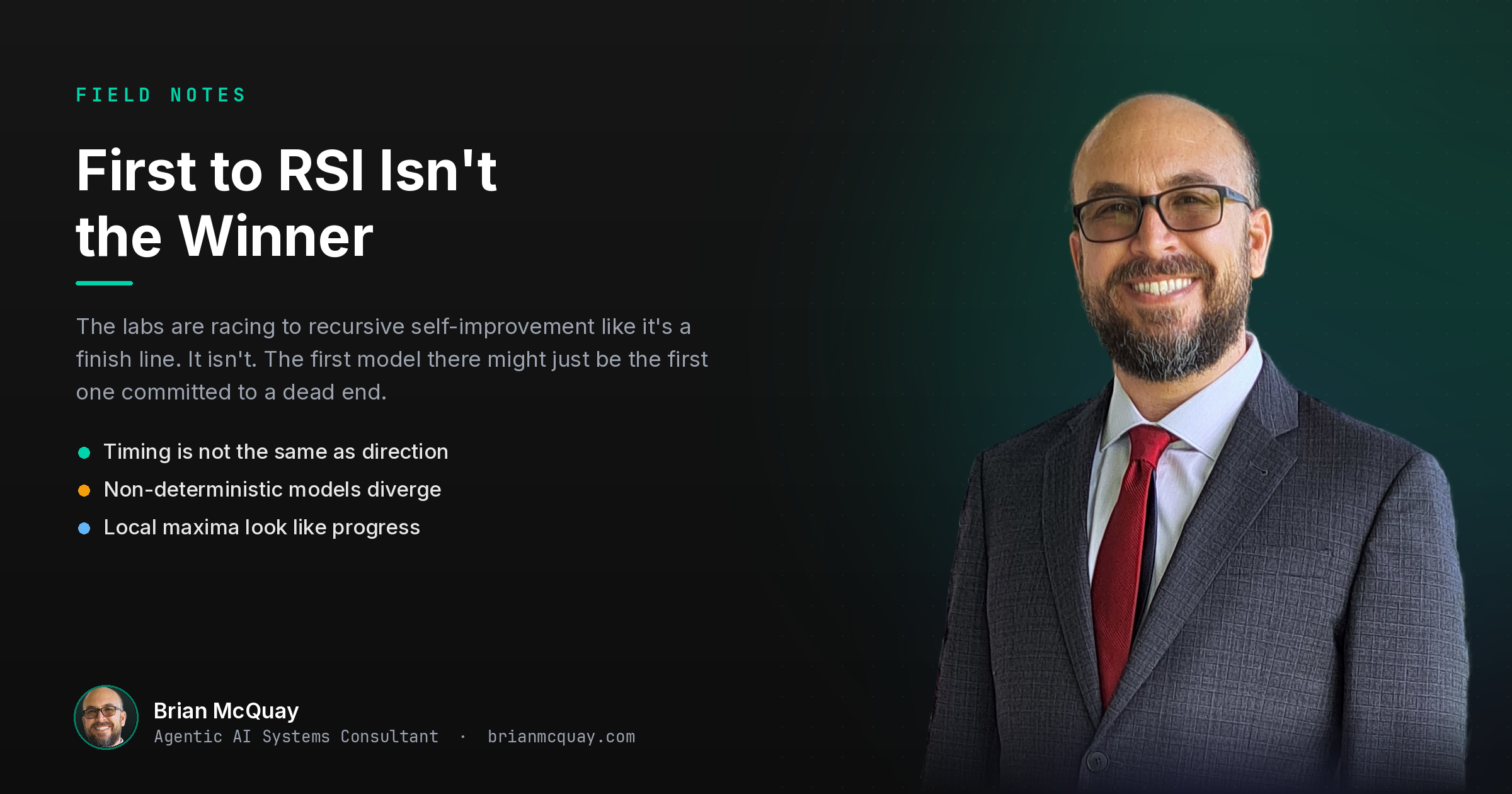
Here's the critical question: which path is better? The race-to-RSI mentality assumes that Lab A's three-month head start guarantees victory, but that assumption only holds if all paths lead to the same destination or if the first path chosen is optimal. In reality, optimization landscapes in complex systems—and I've worked with enough complex distributed systems to know this intimately—are riddled with local maxima. Path A might lead Lab A's model to rapid improvements that eventually plateau at a local maximum. Path B, despite starting later, might lead to a higher plateau, a more efficient route to greater capability. The first mover advantage evaporates if you're racing down a dead end.
The Constraint of Compute and Decision Points
The frontier labs also seem to be assuming unlimited compute resources, but that's not reality. Even with massive computational power, there will be constraints. At every step of the recursive improvement loop, choices must be made about which experiments to run, which hypotheses to test, and which improvements to implement. You can't explore every possible direction simultaneously—you have to prioritize, allocate resources, and make bets on which paths look most promising. These decision points are where the non-deterministic nature of the models intersects with resource constraints to create divergent outcomes.
Think about what this means in practice. A model in an RSI loop has to evaluate its own architecture, identify weaknesses, propose solutions, test those solutions, and then decide which to implement. Each of these steps involves uncertainty and trade-offs. Testing takes compute. Implementing changes requires commitment to a direction. Even a superintelligent system can't simultaneously pursue every possible improvement path—it has to make choices, and those choices have opportunity costs. One lab's model might invest heavily in improving its reasoning capabilities through one architectural approach, while another lab's model might focus on a completely different aspect of cognition. Three months of head start doesn't matter if you spent those three months optimizing in a less productive direction.
Why Reaching Superintelligence Doesn't Mean You Win
This brings me to my core argument: hitting recursive self-improvement first doesn't guarantee that you win the superintelligence race. The finish line isn't reaching RSI—it's reaching the most capable, most powerful AI system. And getting to RSI first doesn't ensure you'll end up with the best system, for all the reasons I've outlined. The non-deterministic nature of these models means different runs will produce different results. The complex optimization landscape means early paths can lead to local maxima while later explorers might find better routes. The resource constraints mean every lab will have to make choices about which directions to pursue, and those choices might matter more than timing.
I've seen this pattern play out in software development countless times over my career. The first team to implement a feature isn't always the one with the best implementation. The first architecture chosen isn't always the one that scales best. Speed matters, but direction matters more. You can move incredibly fast in the wrong direction and still lose to someone who moved more deliberately toward a better destination. The frontier labs racing to RSI seem to be optimizing for speed without fully accounting for the fact that the terrain they're racing across isn't a straight track—it's a complex landscape where the route you take might matter more than when you started running.
Building for the Long Game
From my perspective as someone who builds systems and thinks deeply about AI's impact on software engineering, the obsession with being first to RSI reflects a misunderstanding of how complex optimization actually works. It's treating AI development like a sprint when it's actually more like exploring an unknown mountain range. Yes, starting your climb early gives you an advantage. But if you commit to scaling the first peak you encounter while someone else finds a route to a higher mountain, your head start becomes irrelevant. The goal isn't to be first to climb; it's to reach the highest point.
This doesn't mean the race to RSI doesn't matter at all. Being in the race is essential. Having the capability to achieve RSI is table stakes. But the cult-like focus on being first, to the exclusion of all other considerations, seems misguided. A lab that reaches RSI second or third but whose model happens to explore more productive optimization paths could easily end up with a superior system. A lab that reaches RSI with a fundamentally better base architecture might find their model's recursive improvements compound more effectively. The variables that will determine the ultimate winner extend far beyond who crosses the RSI threshold first.
What This Means for the Field
So what should we take away from this? First, that the narrative around AI development—the winner-takes-all, race-to-RSI story—is probably oversimplified. The dynamics of non-deterministic systems in complex optimization landscapes are more nuanced than a simple race metaphor suggests. Second, that diversity in approaches might actually be beneficial for the field as a whole. If different labs reach RSI at different times with different architectures, they'll likely explore different optimization paths. Some of those paths will be more fruitful than others, and we won't know which ones until they're explored. Third, that perhaps we should be paying as much attention to the quality of base models and the thoughtfulness of improvement strategies as we do to the timing of RSI achievement.
The cult of RSI in the frontier labs might turn out to be right—maybe the first to achieve recursive self-improvement will indeed win decisively. But based on what I understand about complex systems, optimization landscapes, and the non-deterministic nature of these models, I'm skeptical. I think we're likely to see a more complicated picture emerge, one where timing matters but doesn't determine everything. One where the path you take matters as much as when you started walking it. One where being a serious builder who understands the systems deeply might matter more than simply being first to flip a switch.
The race is on, and it's fascinating to watch. But let's not assume we know how it ends just because we know who starts running first. The finish line is further away and in a more uncertain direction than the current narrative suggests.