The Future is Here: Automatically Optimizing API Endpoints with AI
What if your slowest API endpoints could fix themselves while you sleep? Not in some distant future, but in the next few months. After spending over 25 years building software in distributed environments, I've seen countless teams struggle with the same problem: they know their endpoints are slow, they know customers are frustrated, but they simply don't have the resources to investigate and optimize every performance issue. The traditional approach has involved engineers proactively setting up alerts for slow endpoints, manually reviewing dashboards, and identifying problematic patterns—but it's an incredibly resource-intensive process that struggles to keep pace with the scale of modern applications. We're at an inflection point where AI-powered automation is about to fundamentally change how we approach API performance optimization.
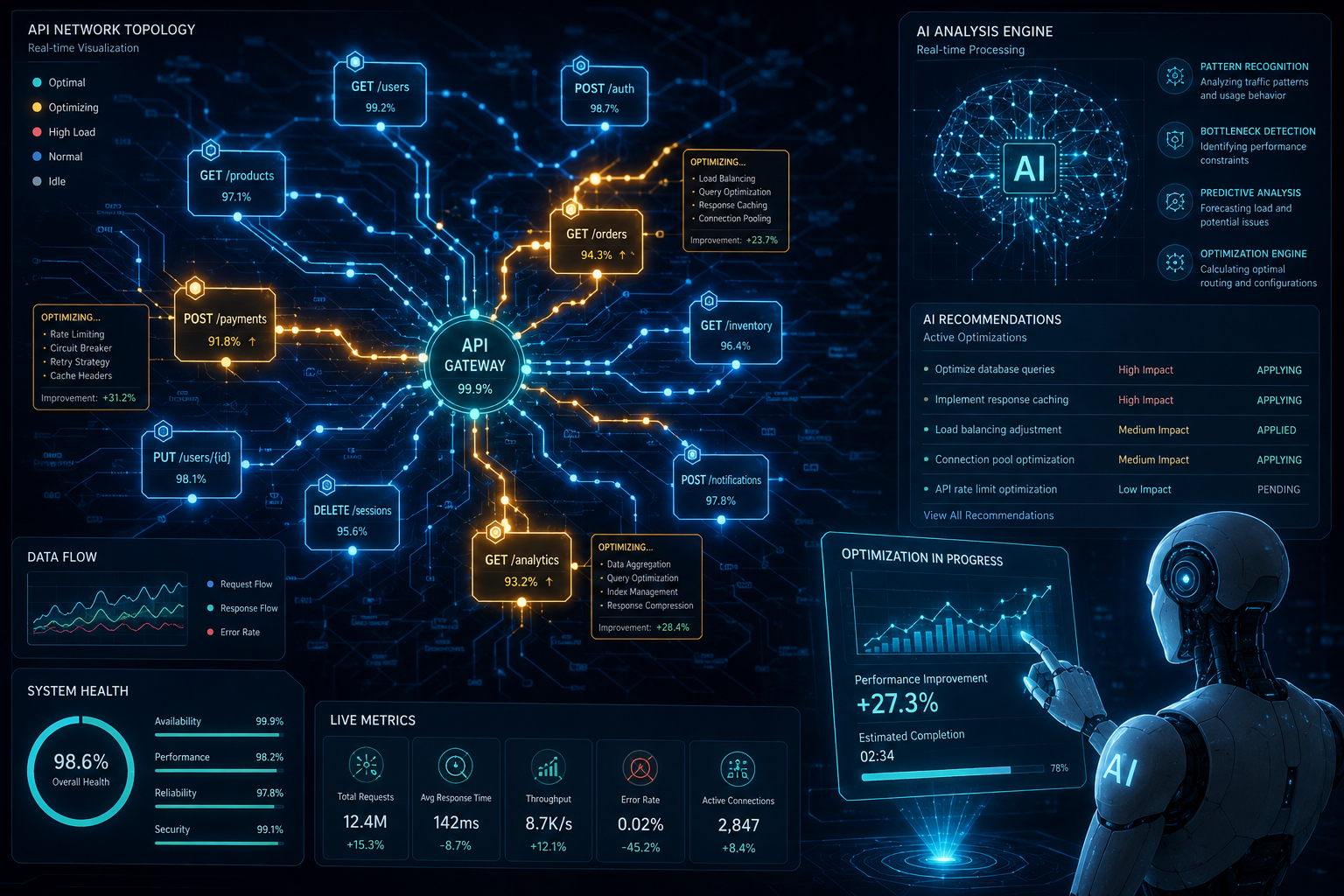
Most applications today are built around APIs with dozens or even hundreds of endpoints serving web apps, mobile clients, and third-party integrations. Every engineering team I've worked with faces the same constraint: limited resources and unlimited performance issues to address. The typical strategy involves setting performance thresholds and configuring alerts to notify engineers when endpoints exceed acceptable response times, but someone still needs to manually triage those alerts, investigate the root causes, and implement fixes. Some endpoints perform perfectly under normal load but degrade significantly during peak traffic, making them intermittently problematic and even harder to prioritize. This manual, resource-constrained approach means that performance optimization often gets deprioritized against feature development, leaving technical debt to accumulate and user experience to suffer.
Why Endpoint Optimization Has Been So Manual
The reason endpoint optimization has remained such a manual process is that it requires deep technical expertise and significant investigation time. Quick fixes might involve eliminating N+1 database queries where your application makes one query followed by N additional queries in a loop, often causing dramatic performance degradation. Other solutions require rewriting complex database queries to be more efficient, adding missing indexes to speed up lookups, restructuring data models, or implementing caching strategies. These aren't trivial problems—they're the kind of challenging technical work that even senior engineers with decades of experience need to carefully think through. You can't just throw junior developers at performance issues and expect good results, which is exactly why I've always found this work both technically satisfying and strategically important for building quality software.
The diagnostic process itself is complex and time-consuming. You need to examine observability metrics to identify patterns, trace through code to understand what's actually happening during slow requests, analyze database query plans, consider the broader system architecture, and evaluate potential solutions against the risk of introducing new bugs. Each endpoint might have unique characteristics that require different optimization strategies, and what works for one endpoint might be completely wrong for another. This is exactly the kind of work that's been the exclusive domain of experienced engineers who can synthesize information from multiple sources and apply pattern recognition from years of debugging similar issues. But that's changing rapidly.
The AI-Powered Optimization Pipeline
Here's where it gets exciting: we're reaching a point where we can automate this entire process using AI agents and orchestration systems. Imagine an AI system that continuously monitors your observability metrics and automatically identifies endpoints that are consistently performing below your target thresholds. Instead of requiring engineers to manually review dashboards or respond to every alert, the system proactively detects the five slowest endpoints and creates individual investigation tickets for each one. These tickets enter your software development pipeline just like any other work item, complete with context about response times, traffic patterns, and observed symptoms. The system does what your engineering team is already doing—monitoring, alerting, and investigating—but at a scale and consistency that human teams simply cannot match.
From there, an AI agent picks up each ticket and begins the investigation process. It examines the endpoint code, traces through the execution path, analyzes database queries, checks for common anti-patterns like N+1 queries or missing indexes, and explores multiple potential optimization strategies. The agent might identify that one endpoint needs query optimization, another needs a database index, and a third could benefit from caching. Here's where it gets even more interesting: the agent can actually implement these potential solutions, creating multiple branches with different optimization approaches. This isn't theoretical—the technology to build these kinds of agent orchestration systems exists today, and I'm actively working on these systems in my current role.
A/B Testing Automated Solutions
The real innovation comes in how we validate these automated optimizations. Rather than simply deploying changes and hoping they work, we can implement A/B testing directly into the optimization pipeline. The system deploys the optimized endpoint version alongside the original, splits traffic between them, and measures the actual performance impact. Did response times improve? By how much? Did the optimization introduce any errors or unexpected behavior? Are there any edge cases where the new version performs worse? This data-driven validation approach means we're not blindly trusting AI-generated solutions—we're empirically testing whether they actually solve the problem without creating new ones.
The system might even implement multiple optimization strategies simultaneously, A/B testing several different approaches to see which performs best under real-world conditions. One branch might optimize the database query, another might add strategic caching, and a third might restructure the data retrieval logic entirely. By measuring actual performance across all variations, the system can identify which approach delivers the best results and promote that version to production. This kind of multi-variant testing would be prohibitively expensive with human engineers manually implementing and monitoring each variation, but becomes feasible when automated by AI agents. What would take a team weeks of dedicated effort—implementing multiple approaches, setting up tests, monitoring results, and analyzing outcomes—can happen continuously in the background while your engineers focus on work that requires human creativity and judgment.
The Challenges We Need to Solve
Now, I'm not suggesting this is a solved problem ready for production tomorrow—there are significant challenges we need to work through. Changes to large database tables require careful consideration around locking, migration strategies, and potential downtime. Any automated system needs guardrails to prevent catastrophic changes, like dropping indexes that other parts of the application depend on or introducing changes that degrade performance in ways that aren't immediately visible in A/B testing. We need robust rollback mechanisms for when automated optimizations go wrong, and we need to ensure the AI understands the broader system context rather than optimizing one endpoint at the expense of overall system health.
Initially, I expect we'll see hybrid approaches where AI agents propose and implement optimizations, but human engineers review changes before they reach production. This "human in the loop" approach provides a safety net while we build confidence in the system's decision-making and develop better guardrails. As the technology matures and we establish patterns for what works and what doesn't, we'll progressively automate more of the pipeline until even deployment and A/B testing run without human intervention. But getting there will require solving some genuinely difficult engineering problems—which is exactly what makes this work so compelling.
Why This Matters for Software Engineering
This shift toward automated optimization represents a fundamental change in how we think about software engineering resources and priorities. Instead of treating performance optimization as work that competes with feature development for limited engineering capacity, it becomes a continuous, automated process that happens in the background. Senior engineers can focus their expertise on truly novel problems and architectural decisions rather than spending time on the tenth N+1 query this month. Teams can maintain consistently fast APIs without constantly making tradeoffs between performance and feature development. The proactive monitoring that engineers already do—setting up alerts, reviewing dashboards, investigating slow endpoints—transforms from a manual process that can only scale so far into an automated capability that handles hundreds of endpoints with the same rigor.
From my perspective as someone who's been building software in distributed environments since before "distributed" was a buzzword, this feels like a genuine evolution in our practice. We've always known what good performance looks like and what optimization strategies tend to work, but we've been bottlenecked by the human effort required to investigate and implement improvements. AI agents don't eliminate the need for engineering expertise—they scale it and apply it more systematically than any team could manage manually. The engineers who understand performance optimization deeply will be the ones building and refining these automated systems, ensuring they embody best practices and avoid common pitfalls.
What's Coming Next
I genuinely believe we're only a few months away from being able to start experimenting with automated endpoint optimization in real production environments. The foundational technologies—AI agents, observability platforms, A/B testing frameworks, automated deployment pipelines—all exist today. What we're doing now is figuring out how to orchestrate them together into a reliable, production-ready system that teams can trust. My work on agent orchestration systems is directly focused on solving exactly these kinds of challenges, and I'm seeing rapid progress in how effectively AI can handle complex, multi-step technical tasks.
The initial implementations will be cautious and heavily supervised, but they'll prove out the concepts and identify the edge cases we need to handle. As we build confidence and refine the systems, more of the pipeline will become fully automated. Eventually, endpoint optimization will shift from a periodic sprint task that competes with feature work to an invisible background process that keeps your APIs fast without anyone thinking about it. That future is closer than most people realize, and it's going to be built by engineers who understand both the technical depths of performance optimization and the emerging capabilities of AI agent systems.
The Builder's Perspective
What excites me most about this isn't just the technical challenge—though that's certainly compelling—it's the practical impact on how teams build software. I've spent my career as a builder, from founding a consultancy where I led teams building custom applications to architecting systems in EdTech to my current work in property tech. I've seen firsthand how resource constraints force teams to make compromises they don't want to make, leaving known issues unaddressed simply because there aren't enough hours in the day. Automated optimization doesn't just make our software faster—it fundamentally expands what's possible for teams of any size.
This is what the AI transformation of software development actually looks like in practice. It's not about replacing engineers with chatbots—it's about building sophisticated systems that augment our capabilities and automate the repeatable parts of our work so we can focus on what requires genuine human creativity and judgment. The teams that figure this out first will have a significant competitive advantage, shipping faster software with fewer engineers while maintaining higher quality. And for those of us who love the challenge of building these kinds of systems, it's an incredibly exciting time to be working in software engineering.